
The main character in my book, “A Jar of Clay, Part 1: Made in Nigeria” (available here) , was born in Nigeria around 1950/1951 and named Dejo. What was Nigeria like in 1951? It was a time of intense political activities and nationalism as Nigeria agitated for self government. Nationalism in Nigeria is not often about the Nigerian entity. Instead, it is often expressed at the level of the individual nations and people group that conglomerate under the “Nigeria” umbrella.
Here are a couple of videos about Nigeria made around 1951 (give or take three years):
I need to warn that the two links above were clearly produced by the colonial government and the content reflected that. I still think they are both informative. For example, Nigeria exported products including Palm Oil, Groundnut, Tin and Cocoa in 1951. Oil did not get a mention.
Here are a number of notable things in 1951:
- Chief Obafemi Awolowo established Action Group (AG).
It was the same year that Ibadan People’s Party was established. some of the major players Included Adegoke Adelabu, Kola Balogun and TOS Benson - Nigeria Medical Association was also established in 1951
- Obudu Mountain Resort in today’s Cross River state was developed in 1951
- In 1951, Chike Obi formed the Dynamic Party. He was around 30 years old then.
The most remarkable thing I found accidentally about Nigeria was its population. Nigeria had a population of 38.4 million in 1951 while her colonial master then, United Kingdom, had 50.6 millions.
Below I show the population, although I plotted the graph, data was sourced from Word Population Pyramid.
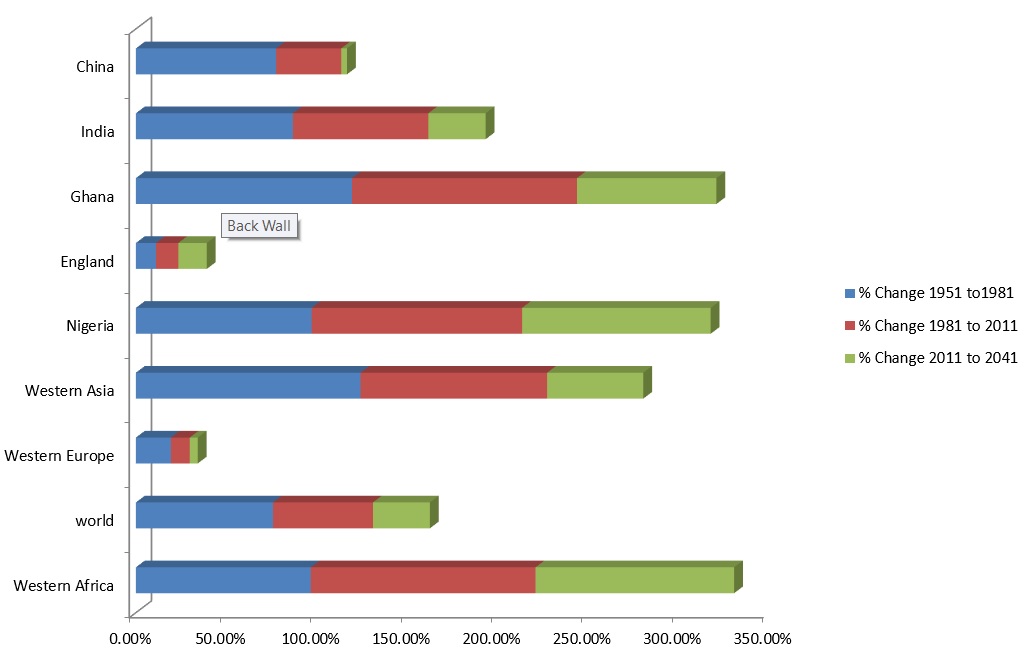
In blue is the population change from 1951 to 1981, in claret is population change from 1981 to 2011 while in green you can see the population change from 2011 to 2041 (projected of course). These changes are shown in percentage.
In the 90 years between 1951 and 2041, Nigeria population would have increased by 874%, Ghana by 887% and West Africa by 922%. In contrast, population of the UK and the whole of Western Europe would have increased by 43% and 39% respectively in the same period.
In numbers, by 2041, England will have a population of 73 million while Nigeria will have a population of 334 million. Europe will have a population of 196 million while West Africa will have a population of 660 million. This is breathtaking, if you consider what population was in 1951 for these nations and regions.
Now look at China and India. They have done something about their population. Between 1951 and 1981, China’s population grew by 77% while that of India grew by 86%. Nigeria experienced a growth of 97% at the time.
Fast forward the clock to 2011. The percentage change in population in that 30 year period for China was 36%, for India, 75% while for Nigeria it was 116%.
Push forward another 30 years to 2041 and you will see remarkable differences. In those 30 years, China’s population growth will be 3%, while India’s population growth will be 31% but Nigeria’s population growth will be 104%.
It is not desirable that the population of a nation doubles every 30 years. That is every 30 years you have twice the mouth that you fed 30 years ago. India and China realised this in 1981 and have worked to do something about their population growth.
It is not too late for Nigeria and West Africa to do something about their population growth. We are where we are now, so we have to look forward and put in place education campaign to control our population growth.
There is a silver lining though: if Nigeria and the rest of West Africa can train these army of people it has produced, then it can turn the population demography to its advantage. Whereas Europe face challenges of an ageing population, the same is not true of Nigeria and West Africa. This is definitely an advantage – only if there is investment in the army of young people of Nigeria and West Africa.

 oyebode.com