
This post is all about Rev Canon Josiah Jesse Ransome Kuti, Fela Anikulapo Kuti’s grandfather.
Earlier this year, I read for the second time a book written in Yoruba titled “Lojo Ojoun” (in the olden days) by Isaac Delano. I am not sure the book is any longer in print anywhere but I found copies at the British Library and the library of School Of Oriental And African Studies, both located in London. When I first read the book growing up, it left some emotional trace and was the reason I wanted to read it again.
While reading the book this time, I came across a picture of the Rev. Josiah Jesse Ransome Kuti and his son, the Rev. Isaac Oladotun Ransome Kuti. It was a surprise to me that the celebrated music genius, the Late Fela Anikulapo Ransome Kuti had such a heritage. Fela was not the man you would typically connect with anything Christian.
While searching for the Delano’s books, I found a biographical book he wrote about Fela Anikulapo Kuti’s grandfather. The book is titled “The Singing Minister of Nigeria: The life of The Rev. Canon J.J. Ransome Kuti” by Isaac Delano. The book was published in 1942 and was written in English. Delano provided some insight about Fela Anikulapo Kuti’s ancestors. From the book, I gathered the information that help me to construct Fela Anikulapo Kuti’s family tree. It is not exhaustive as I left out his siblings and focus on that part of his ancestry that gave some context to his musical genius:
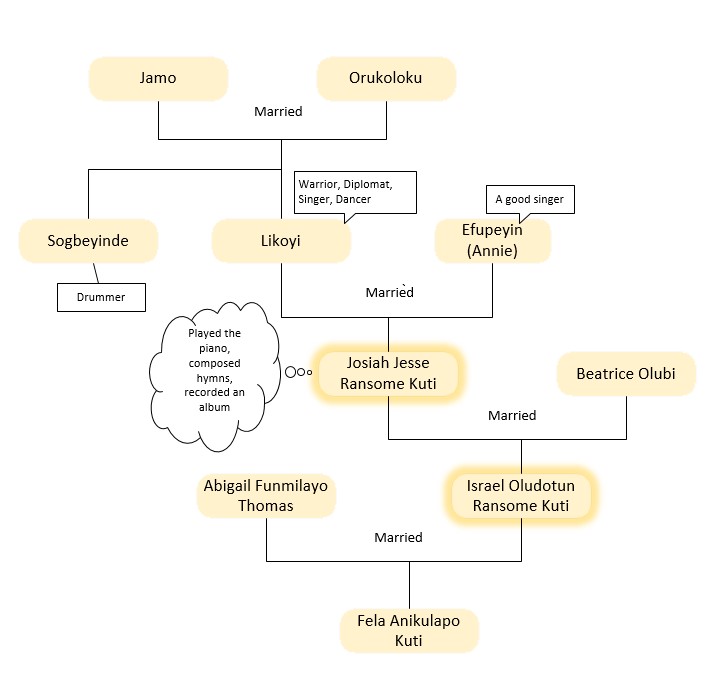
Jamo was Fela Anikulapo Kuti’s great, great grandfather. According to Delano, Fela’s ancestors were in public service, serving as soldiers and successful traders. Originally based in Orile, the ancestral home of Igbein people, they drifted to Abeokuta.
Not much was said about Jamo, apart from having two sons, Likoyi and Sogbeyinde. Likoyi was described as one of Egbas’ greatest diplomats and a weaver by trade. The Egbas are a people group in the South West of Nigeria. Likoyi’s hobbies included singing and dancing. Sogbeyinde was described as a singer and dancer. To produce two sons who were musical, it is probably likely that Fela’s great, great grandfather himself was musical.
Fela Anikulapo Kuti’s great grandmother was Efupeyin. I think it should be written “Efunpeyin” because she was a worshiper of Orisa-Oko (the farming deity?). She converted to Christianity in 1848, bringing the Christian faith into the Kuti lineage. She took the name “Annie”. She was one of the earliest Christians among the Egbas.
Josiah Jesse Ransome Kuti, Fela Anikulapo Kuti’s grandfather was born on June 1855. At one point, Annie ran away because of rumors her son would be killed because she was a Christian. Likoyi persuaded her to come back home, vowing to defend his son from any evil doer. Annie was free to worship but Likoyi did not want her to take his son to church and was against his baptism. Likoyi would take his son to fetish idols to eat meat sacrificed to idols. Later in life when Josiah Jesse Ransome Kuti was asked about his consumption of those meats, he quipped that he liked eating them.
Eventually, Josiah Jesse Ransome Kuti was baptized at a Wesleyan Church in Ogbe in 1859. Annie and Josiah became Anglicans when Annie was cast out of the Wesleyan church due to a visit to a CMS church to be with two of her friends.
Annie was also described as “a good singer”, a native of Imo and niece of Solanke, a Balogun (War Chieftain) of the Egbas. Due to the different religious persuasion of his parents, Josiah Jesse Ransome Kuti said he often ate meats at idol shrines and missionaries’ biscuits on the same day.
While at Igbein Primary School, Josiah Jesse Ransome Kuti fell ill and Annie demanded he came back home. For a whole year, Annie taught him indigenous music and tunes, and, the language of native drums. When Josiah Jesse Ransome Kuti returned to school, the musical mentoring by his mother paid off, and he excelled as a student, especially in music. by 1880, Josiah Jesse Ransome Kuti was a teacher at CMS Girls School, Lagos, where he taught and practiced music. He was described as polished musician, a great singer, who “accompanied himself on the piano or harmonium with ease and confidence”. He was so good he could have been a success on the social scene. However, based on the advice of a German missionary, Mrs. Mann, he decided to dedicate his talent to the Lord and consecrated his musical talent to Christian music.
On May 2, 1882, Josiah Jesse Ransome Kuti married Beatrice Olubi.
Rev Canon Josiah Jesse Ransome Kuti would go on to build significant work at Gbagura, Sunren-Ifo District, Ilaro, Ake Church Abeokuta, among several other places. A prolific musician, he authored indigenous music that struck a chord with his people and drew them to his open-air events. He was an educator who at one time had sixteen boys and girls under his roof as an informal boarding house. Adjudication in certain matters were delegated to him by the colonial administration. During his long career in the ministry and public service, he was a mediator in various conflicts, the most notable of when the Egbas resisted taxation by the colonial government.
On a visit to the United Kingdom in 1922, he made some gramophone record of his songs.
Not only is Rev Canon Josiah Jesse Ransome Kuti grandfather to Fela Anikulapo Kuti, he was also grandfather to the first African Nobel Prize winner, Professor Wole Soyinka.
Some of the quotes in this article comes from “The Singing Minister of Nigeria: The life of The Rev. Canon J.J. Ransome Kuti” by Isaac Delano, published in 1942.

 oyebode.com
1 thought on “The Musical Heritage of Fela Anikulapo Ransome Kuti”