
Recently, I wrote about Fela Anikulapo-Kuti’s musical heritage (read here). Rev Jesse Josiah Ransom-Kuti was Fela’s grand father:
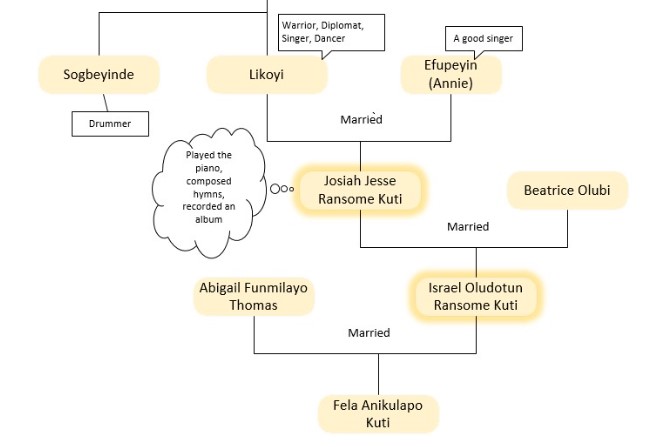
Rev Josiah Jesse Ransome-Kuti took a very radical and practical approach to his faith, and that approach brought conflict with the Anglican Church. A very good example was when he allowed the “Ogboni Fraternity” to hold a thanksgiving service in his church.
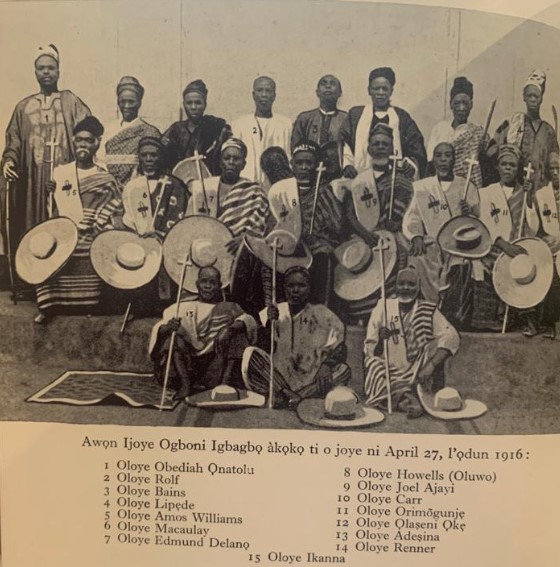
The “Ogboni Fraternity” attended a service officiated by Rev Josiah Jesse Ransome-Kuti on April 27, 1916. Here is a picture of the attendees (source “Lojo Ojoun” by Isaac Delano).
First, a brief history of the “Ogboni Fraternity”. It is a fraternity that is indigenous to Yoruba speaking part of West Africa, specifically Nigeria, Republic of Benin and Togo (read more here). Before colonialism, it was the premier political authority, especially among the Egbas. The Ogbonis Fraternity was superior to the king. Note that before colonialism, the people groups in Nigeria and the rest of West Africa saw each people group as a nation. It was the commercial interest of the colonial masters that led to the amalgamation of the different people groups into countries.
It didn’t come as a surprise that when colonialism and Christianity arrived, the Ogboni fraternity came under pressure. First one would imagine that a political association could be a rally point for political resistance. Furthermore, the Yorubas are in “all things religious” ,therefore, the practices of the Ogboni fraternity then would have been steeped in the Yoruba traditional religion. One can understand why the original form in which the Ogboni Fraternity existed, “Aborigine Ogboni Fraternity”, became a problem for the early Yoruba Christians. As a result, the “Reformed Ogboni Fraternity” was formed in 1914 by an Anglican cleric. The “Aborigine Ogboni Fraternity” was weakened by at least two factors. Firstly, its connections to traditional worship put membership at odds with the Christian faith. Secondly, it was in the interest of the colonial masters to prevent a rallying point for political resistance. After the advent of colonialism and Christianity, the “Aborigine Ogboni Fraternity” was reduced to a nominal association, stripped of real power.
Over the years, illustrious Nigerians beyond Yoruba speaking areas have been members of the Reformed Ogboni fraternity. These included Sir Adeyemo Alakija, Chief Ladoke Akintola (Premier of Western Region in the first republic), Sir Adetokunbo Ademola (one time Chief Justice of Nigeria), King Olubusi Sijuwade who was the Ooni of Ife and a successful business man in his life time, King Geroge VI of the UK, Dr Nnamdi Azikwe (President of Nigeria during the first republic), Sir Ahmadu Bello, the late Sardauna of Sokoto (the first Premier of Northern Nigeria) and Chief Olusegun Obasanjo a former Head of State and President of Nigeria (source).
I am not certain that the members of the “Ogboni fraternity” that came to offer thanksgiving and also addressed the church led by Fela Anikulapo Ransome-Kuti’s grandfather were part of the Reformed Ogboni Fraternity” but it is highly likely. The Thanksgiving service at Kuti’s church took place less than two years after the “Reformed Ogboni Fraternity” was formed.
The visit of the “Ogboni fraternity” was controversial to say the least. Please note that the account of the visit that I outlined here is probably sympathetic to the “Ogboni fraternity” because it is sourced from the book “The Singing Minister Of Nigeria” written by Chief Isaac Delano. If you look at the picture of the chiefs of the “Christian Ogboni Fraternity”, you will observe that “No 7” in the picture is one Edmund Delano, who happened to be the father of Chief Isaac Delano.
According to Isaac Delano, the Ogbonis who came to worship at a service presided by Rev Josiah Jesse Ransome-Kuti were just a prayer group that met every first Monday of the month. They decided to form themselves into a society and gave themselves Ogboni titles. Why did they do this? Due to their adherence to the Christian Faith, they were not allowed to join the “Aborigine Ogboni Fraternity”. Therefore, they were denied the title they could have attained as members. It was their hunger for position that led them to take Ogboni titles and the outward symbols, according to Delano. Delano in his book “The Singing Minister of Nigeria wrote:
These Christian Ogbonis had no political significance beyond settling petty matters between Christians so they should not go before heathen judges for justice. They had as their badge the sign of the Cross, which emblem was conspicuous on their staff of office and on the Itagbe. Their motto was ‘Faith, Hope and Charity’. They drew up laws and regulations to govern themselves. They were not more than a social fraternity like Freemasonry, for example. They went into the Church of God and asked Kuti to hold a Thanskgiving service for them after the Easter Service of that year 1916. “After having studied their rules and know the object of the Fraternity, he (Kuti) said ‘I held the Thanksgiving service for them”.
What did Rev Josiah Jesse Ransome-Kuti think about the whole incidence? We can catch a glimpse of this from his notes, from which Isaac Delano drew heavily in his book:
My actions in Ake Church in bringing those sin-laden elderly Christian Ogbonis into the House of God and before the Throne of Grace to give thanks offerings after prayer and address was my offence
What are we to make of this? What did Rev Kuti mean by “sin-laden elderly Christian Ogbonis”? Did he mean this in the context of Roman 3:23, that “all have sinned and fallen short of the glory of God”? Or did he mean this because of the specific practices of the members of these “Christian Ogbonis”? This is open to interpretation but from a letter that he wrote to one Rev E.W. George, in 1919, we gain further insight into his thinking:
Does the church of England forbid Societies like Freemasons? Do the Elders at Ake Church (the Christian Ogbonis) pray to Demons? Is having Thanksgiving to the God of our Salvation idolatry? “Mine house shall be called a house of prayer for all people” – see Isaiah 56 v 7. The God Almighty has said that. And who are you and what are you to say “No” to that or condemn?
Finally, please take a piece of advice from the poor sinner and unworthy rustic Josiah Jesse Ransome-Kuti. Do not constitute yourself a critic, a judge, a fault finder or false accuser. I am your brother in the blessed Service of the Lord Jesus
Clearly, Rev Ransome-Kuti believed his actions were consistent with the teachings of the Church and the bible.
He escaped with a warning from the Anglican Church.

 oyebode.com