
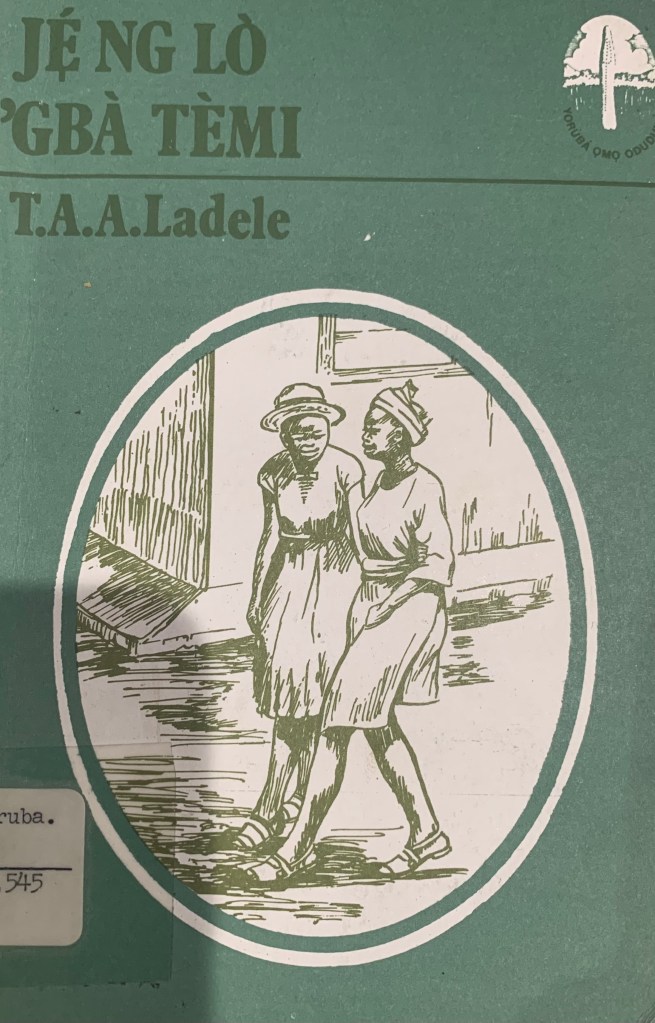
This short post is about the first page of JE NG LO GBA TEMI by TAA Ladele, a book written in 1971. A work of fiction but I believe fictions always have some basis in reality.
JE NG LO GBA TEMI can be translated “Let me have fun”, “I want to enjoy this season of my life”. The book explore the impact of Christianity and the “ilaju” (development) that accompanied the religion on a fictional town called Owo ,using the choices made by two young girls, Adeoti and Eeesita (Yorubanisation of Esther). This post will just focus on the first page.
The first few words were non controversial and they introduced us to Adeoti’s background: she was born into a middle income family where there was no struggle to make ends meet. The moment the readers were told that although Adeoti’s mother was overjoyed to have a girl, her father, Bankole did not share the same feelings, things took a different turn, at least from the point of view of a reader like me who is based in the UK. I will translated the words that shocked me:
We cannot blame Bankole for being disappointed his first child was female. Who does not know that the first child is the heir? Yes, the first child is the heir. Who wants the girl as heir? A girl scatters her father’s house because, no matter how much she loves her parents, one day she will marry, move to her husband’s house, visiting her parents’ house once in a while. On the other hand, a boy builds and expands his father’s lineage because he would go and marry and bring up children in his father’s house, he may even have two or three wives.
Yes, JE NG LO GBA TEMI is a fictional work but it is hard to conclude TAA Ladele just made this up. These few sentences show that at some point in their history, the Yorubas valued boys more than girls. Based on the short passage, it seems to be due to the fact that a girl marries and leaves home eventually. A girl takes the name of her husband but double barrel names are now allowing girls to carry their family names, in addition to their husbands. Did people in the South West of Nigeria really perceived the female child in this manner?
Evidence abounds that the girl from the South West of Nigeria does not have the same status as the boy. The Yorubas have an expression “Olori Ebi” to describe the head of an extended family. Invariably, “Olori Ebi” is the oldest male. In royal families, only the men can aspire to become kings though girls/women can serve as regents, a temporary assignment. Traditional chieftancy titles are generally a men only affair, apart from titles such as Iyalode (the leader of all women), Iyaloja (the leader of all market women) and the more modern traditional tiles that are convered based on achievements.
In the South West of when I was growing up, if you take a superficial look, you would see equal opportunities for boys and girls. Regardless of gender, there was equal access to education. And girls did as well as boys academically. I remember that the best student in the department of Computer Science during my university days was female. In our family, a boy did not have any special privilege. As a boy, I ironed my parent’s clothes, a task that I detested and filled my saturdays with boredom. I took part in household chores like sweeping the floor. On days when we cooked pounded yam for lunch, the youngest two that are strong enough participate in the task, regardless of gender.
I do think there were subtle differences in how boys and girls were brough up because their role in the society later in life are not considered identical by the Yorubas. Girls would stick around their mothers, so they learn some practical skills such as cooking and nurturing younger children in the process. However, a boy who is close to his mother could pick up the same skillset if he sticks around her, and I know several examples who did.
Honestly, I have thought very hard and it is hard for me to say that I found evidence that the male child was treated with more privilege either in the school system or in our family circle. What I think existed was different expectations based on what the culture expected from the different gender later in adulthood. I think this can be found in marriage dynamics but the same apply in Europe. For example, paternity leave is a very new thing even in western culture, showing that there has always been different expectations about the role of men and women in society.
Although TAA Ladele wrote in 1971, his book may have reflected how things were when he was much younger. He might have been giving us an insight into the thought processes of the Yorubas of a few decades earlier. It is also worth pointing out that it is not only among Yorubas that different expectations exist about the roles of men and women in society. Social Psychologists have observed this difference in Western culture, they often cite the example of how men are often thanked by their wives when they do household chores, as if they are doing them a favour.

 oyebode.com