
T.A.A Ladele published his book, JE NG LO GBA TEMI in 1971. He was born in 1920 and therefore was 51 years old at the time of writing. The events in his books could have taken place as early as 1925.
There are many translations we can make of this title but I will simply go for “Let my enjoy my fleeting season of youth”. I went for this because it reflects the story much better than others that occurred to me.
The Yorubas of the South West love to party and have fun. Therefore, it is not surprising that musical instruments abound, the most majestic being the talking drum, in my opinion. Nevertheless, in the first few pages of JE NG LO GBA TEMI, we catch a glimpse of how novelty can capture the human imagination. Despite all these local drums, the Christians used the novelty of the brass drums to grab the attention of the people of the South West.
JE NG LO GBA TEMI was set in a fictional town called Owò (not the same as a real town called Òwò in the current Ondo state). The main event in the first few pages of JE NG LO GBA TEMI was an evangelistic team that literally danced into the town in a very comical and comedic manner. The image below from the book is a good illustration:
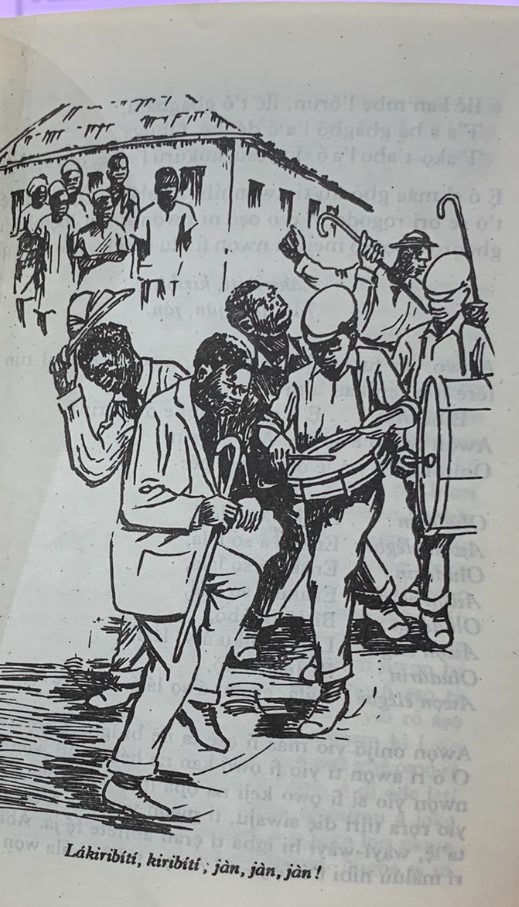
The author went on to provide a vivid description of their entrance and the impact on the people.
The fictional Owò town (really village but Yorubas don’t ever admit there place of origin is a village😂😂😂) was very small, off the beaten track and without a motorable access. Nevertheless, the Christian evangelists came and arrived in style. Their entrance was signaled by “omele eebo”. The Yorubas have a drum called “omele”. “Eebo” can be translated “white”. Therefore, this combination suggested it is a new type of drum that was introduced by the foreign missionaries from the UK who brought the gospel to Nigeria. My thinking is this refers to the smallest drum in the set. The first thing the inhabitants of Owo heard was the sound of “omele eebo”:
Lakiribiti kiribiti!
Followed by:
Jan, jan, jan, jan
The Yoruba language is onomatopoeic, speakers of the language would quickly recognise these sounds. In fact whoever has heard most national anthem played and are speakers of Yoruba would quickly know which drums are in question here.
The drumming was just the tip of the iceberg. It ushered in the evangelists who danced in a rather theatrical manner. As you can see in the image, they are all exclusively dressed like the English, wearing suits and shirts. They sang and called out to “idol worshippers” to come and accept the gospel, naming the local gods like Sango, urging people to stop worshipping gods made by people.
It was their dance that caught the attention of the people. Ladele likened the dancers to a cricket scratching the ground. Some of the dancers held the helmet on their head with one hand, the walking stick raised up by the other hand (walking stick was probably just part of their dressings in those days), their heads pushed forward, behaving like cows tied down that wanted to break free. Some of them did not take off their helmet, instead, they use one hand to hold the left collar and the second hand to hold both the walking stick and the right collar, spinning around as they danced.
The impact of their dramatic entrance was people trooping out of their houses as they rushed out not wanting to miss any of the action. People appeared to just abandon whatever they were doing, children and adults alike. Some had in their hand the food they were just about to swallow. Many did not even wait to put on their shirts before they hurried out, displaying a variety of “ikun” and “idi” ( I will not bother to translate these).

 oyebode.com
Thank you very much for the introduction to “Je N Lo’gba Temi.” It brought sweet memories. I wish I can lay hands on some of the Yoruba classics of the yesteryear. On a lighter note, Yoruba settlements are towns and cities☺️
LikeLike