
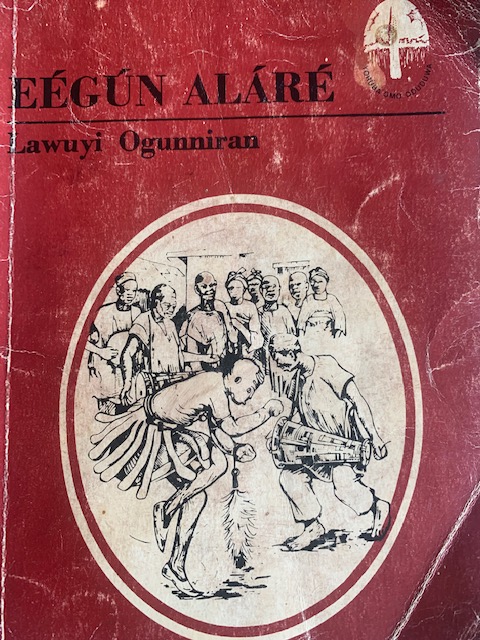
When I was growing up, authors of Yoruba novels were very prolific. This novel came to my attention in year 8 as it was our text for Literature in Yoruba language. It was written by Lawuyi Oguniran (navigate the link to his Wikipedia page).
As I read the book recently, I was struck again by the richness of the Yoruba culture and language. The Yoruba language itself is a tonal one: a word has no meaning until you know the tone and the signs that guide its pronunciation.
Poetry is all over the Yoruba language and culture, it shows up everywhere. Each family has its own poem. Towns also have poems about the people, their history and environment. Poems and rhymes are used to celebrate and extoll. They can also be used to mock. The closest to how poetry is used in Yoruba culture is a musical theatre in the UK.
In the preface to Eegun Alare, Ogunniran identified four forms of poetry:
- ewi: this is straight forward poem, verses that are recited as if somebody is reciting a rhyme.
- onirara: these are praise singers. Often found in the royal courtyard but they can turn up in various social events, whether formal or informal.
- ijala: When hunters and warriors gather together for their events, they will communicate using ijala. Ijala is like a poem that is sung with a ritual and religious edge. Legend has it that at such gathering, there could be some display of Yoruba “powers”. Having never witnessed such or met anybody who did, it is difficult to verify.
- Esa: This is another poetry used by Eegun Alare performers and played a big part in Ogunniran’s book.
I translated Eegun Alare as magician masquerades. In Yoruba culture, Masquerades are “ara orun” (heavenly beings). In many Yoruba towns, masquerades come out once a year, during a particular week. It is a form of ancestral worship. Ogunniran in the preface to Eegun Alare wanted to distinguish them from the annual masquerades. He described them as masquerades that move from town to town throughout the year, entertaining people with their supernatural power display. Legend has it that these masquerades can turn into snakes, though Oguniran himself never witnessed such an event.
What Ogunniran wanted to celebrate was how these magician masquerades use another form of Yoruba poetry, Esa to communicate with one another. He believed that Esa was already dying out. As people in Yoruba speaking area converted to Islam and Christianity, they branded vast aspect of our culture as pagan worship. There is a balance to be struck. The Yorubas are very spiritual people, so, culture and religion are hard to separate. In fifty years’ time, Ijala and Esa may be lost to the Yorubas because of their “pagan” connotations. We need to find a formula that will preserve cultural heritage so we don’t throw away the baby with the bathwater.
I will wrap up by looking at how a couple who were about to be separated for a while said goodbye to each other in Ogunniran’s book.
There were two very good friends, Oje Larinaka and Oje Dasofunjo. Oje means both were Eegun Alare, and travel around entertaining people with their magical skills. Larinaka decided he wanted to seek a new base and had to leave his wife who was expecting their first child at home by herself.
As they parted, Iyadunni, Larinaka spoke to her husband in Esa
Baale mi, oko mi,
Iremogun, omo Awuse,
Iremogun, ara Ilagbede, a-wo'rin-tun-rin-ro
Ba a rebi, a da ni logun odun
Ba a rajo, ada ni logbon osu
Oje Larinnaka nlo, ko da'gba kan
Oje Larinnaka, oko Iyadunni Elegun
Oje Larinnaka, dakun ma gbagbe mi
........
I will translate line by line. In the first line, Iyadunni addressed Larinnaka as her lord and husband. In the next two, she reminded him about his ancestry. Clearly, the ancestors of Larinnaka worshipped Ogun the god of iron: a-wo’rin-tun-rin-ro is an iron worker, somebody who can shape iron, probably blacksmiths, who were Ogun worshippers by heritage.
Larinnaka’s wife continued by saying typically people would indicate how long a trip will last but her husband is travelling without specifying a returned date. There is a sense of premonition that this trip might be life changing for her. She then begged her husband not to forget her, putting it in a very moving manner and three times she repeated that statement while she was in this musical dialogue with her husband.
After Iyadunni was done, Larinnaka replied:
Ooto ni, bee naa ni
Oju o ni o o ti, o o ni te
Emi l'Egun Alare, a bi koko leti aso
Emi l'Oje Larinnaka, oko Iyadunni,
Orimoogunje, oko lemi agbe
Iyadunni, o, dakun ma ya lehin me
Bi ko sigi lehin ogba, wiwo ni i wo
.....
Iyadunni o, dakun ma gbagbe me
.........
Larinnaka started with prayers that his wife would neither be disgraced nor be ashamed. He constructed his identity from his profession as an Egun Alare and also as the husband of Iyadunni. Using the same phrase as Iyadunni did earlier, he beseeched her never to forget him and promised never to forget her. In verses I did not show above, he waxed lyrical on the theme of forgetting using several metaphors and figures of speech. Clearly we have a couple who are deeply in love, just about to part and very emotional about it.
Critical parts of the book are written in Esa, poems that would have been chanted. I hope these poetry are not lost to our culture.
If you follow this link, you will hopefully come across a few examples of these Esa performance. You will also spot why this artform is dying out. They are mostly used during Egungun festival and often used to worship ancestors, something that will make devoted Christians and Muslims uncomfortable. I think we need to be able to separate some of these arts from their worship dimension so that they can be preserved and enjoyed.

 oyebode.com
Wow! Insightful – Yoruba psalms perhaps?
LikeLiked by 1 person
Very good point. They sound like psalms.
LikeLike
The prophetic Hebrew literature uses parallelism in describing issues and brings them to life. These can be likened to the Yoruba language for example I read Isaiah 1:3 which uses the Ox and Donkey intuition with the behaviour of mankind. It kind of reminded me of the way Yoruba would be used.
LikeLiked by 1 person