
I am Yoruba from South West of Nigeria. I will like to unbundle the religion of the Yorubas from our culture because I am a Christian and do not worship God in the manner in which my ancestors did, but I think interesting things in our culture is bound up in our religion. Unbundling the religion of the Yorubas from their culture is a very tenuous and difficult project.
I am a Christian from the South West of Nigeria. However, when I arrived in the UK many years ago, inadvertently, not by design, I joined a British church. Simply because 34 years ago, there were not many churches with big Nigerian population/leadership in the South West of London where we lived.
I remember the first time we were invited into the leadership team, just three months after I arrived. I told our pastor at the time we would not stay long in the church. My eyes were on Kensington Temple and Victory Christian Church, Finchley Road where some of our friends worshipped and with a large concentration of Nigerians. Some Sunday evenings, we would travel down to these churches.
Within two years, my wife and I pastored that branch in unpaid capacity and did it for two years. We were there for seven years. That church changed my understanding of Christianity. There is a concept in social psychology called “situated knowledges”. The central idea is that all knowledge is produced from somewhere. No observer sees the world from a completely neutral, detached, “view from nowhere.” The Christianity I practiced in Nigeria was very much situated in the cultures of South West Nigeria where I grew up. It had some answers to questions that are never asked in the UK and it cannot answer questions that are asked in the UK that are foreign to Nigeria.
The late Bolaji Idowu, a graduate of Cambridge and University of London had a chapter in one of his books with the title “In All Things Religious”. Eight years ago, I wrote an article about that chapter (you can read it here) as a promotion for my book, A Jar of Clay, Part 1: Made in Nigeria. As I sat down this evening to write this, I fished out the article and copied this quote from there:
However, the real keynote of the life of the Yoruba is neither in their noble ancestry nor in the past deeds of their heroes. The keynote of their life is their religion. In all things, they are religious. Religion forms the foundation and the all-governing principles of life for them. As far as as they are concerned, the full responsibility of all affairs of life belongs to the Deity; their own part in the matter is to do as they are ordered through the priests and diviners whom they believe to be the interpreter of the will of the Deity. Through all the circumstances of life, through its changing scenes, its joys and troubles, it is the Deity who is in control
Before Christianity arrived in the South West of Nigeria, the Yorubas were already religious. They had their spirituality. Some will say the image below captures most of the element of the spirituality of the ancestors of the Yorubas and their religion.
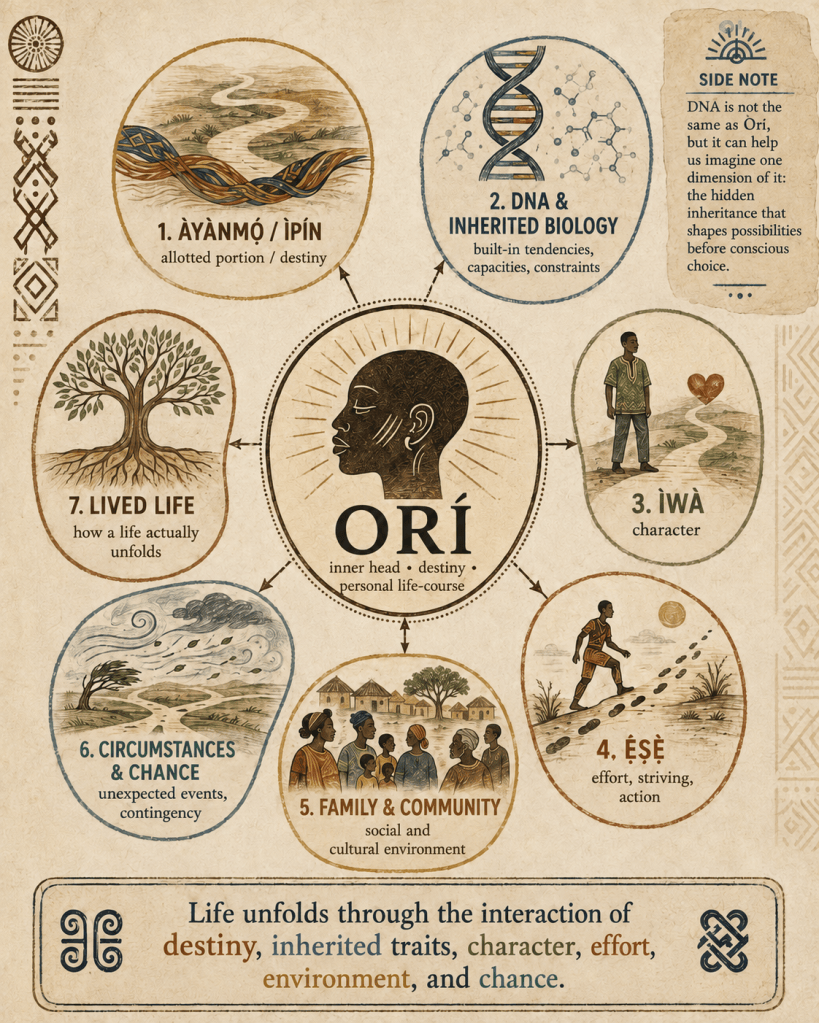
I gave Claude.AI a table containing these topics, and it created this image. The closest to art that I can do is wen my head is stuck behind a camera. Please blame Claude.AI for that PBAT like image lol.
What I am describing as the Yoruba system of thought is actually quite sophisticated and remarkably consistent with reality. We do inherit certain traits, nature, which may give us particular talents or dispositions. But talent still has to be developed through hard work. Our environment, how we are brought up, the mentoring we receive, the opportunities available to us, can either enable or constrain us. The society, community and friendships within which we are situated also matter. And finally, luck, chance, or simply being in the right place at the right time can be critical.
Interestingly, the biblical teaching of predestination has never seemed to be as troublesome among Christians in the South West of Nigeria as it has been in some Western Christian traditions, where predestination has generated centuries of debate, controversy and competing interpretations. In the South West, we seem to take the idea more readily in our stride. Could this be partly because concepts such as Àyànmó and Ìpín, destiny, have existed in Yoruba cultural memory for generations?
By the way, take a close look at how Christianity is practised in the South West and you can still see many of these underlying concepts very much alive.
When Christianity arrived in the South West of Nigeria, it did not arrive in a cultural or spiritual void. It encountered a society in which people already possessed developed understandings of morality, ethics, destiny, community and spirituality. Christianity entered into conversation with that existing world, sometimes challenging it, sometimes transforming it, and sometimes absorbing elements of it into the way the new faith was understood and practised. Christianity became situated in the culture, religion and spirituality of the people of South West of Nigeria.
When you have the opportunity to worship in a social and cultural environment quite different from the South West, the contrast can hit you like a ton of bricks. Things you may previously have assumed were simply “Christian” suddenly reveal themselves to be, at least partly, cultural expressions of Christianity.
This is also partly why people often retreat into their own cultural or ethnic communities. Worshipping among people who share many of your assumptions, instincts and cultural references is simply much easier.
One day, I will return back to this topic. It remained an open ended exploration, a topic that has fascinated me for many years. Everyday, I hear something or I read something that brings this topic back to my mind.


