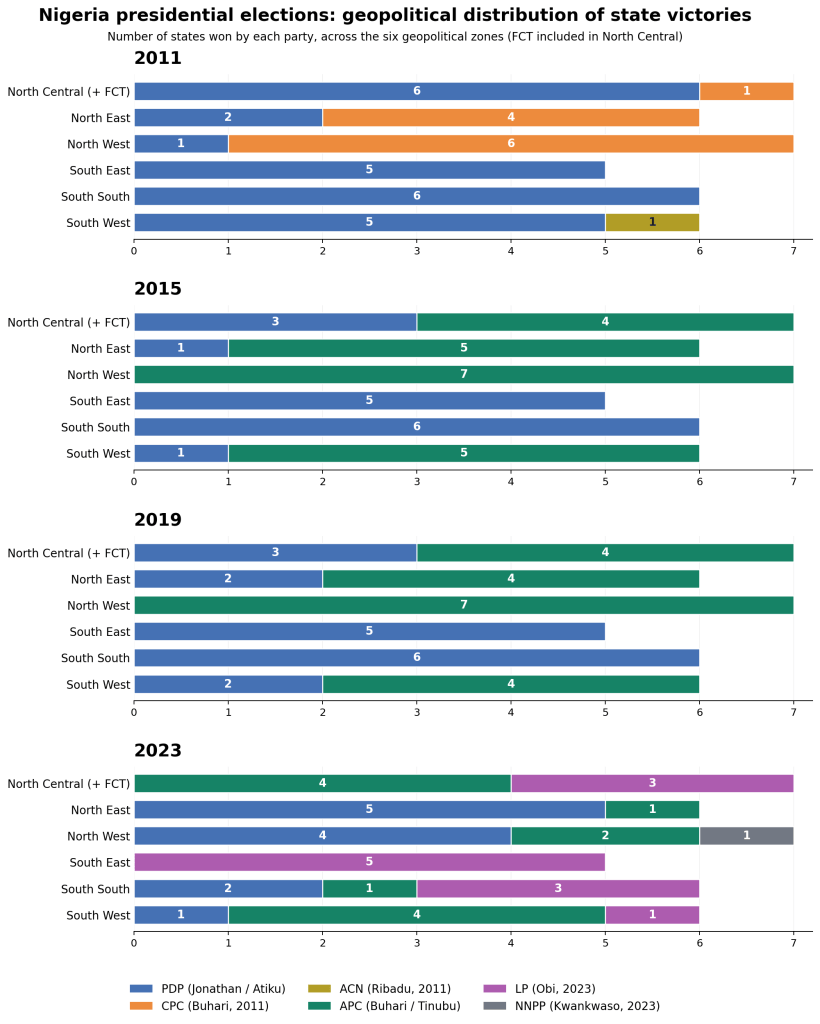
I come across people who claimed certain political candidate won the 2023 presidential election. Their claims do not fit the reality of how people vote in Nigeria, and the strengths of various candiates in different geopolitical zones. It is self-deception to ignore the reality that political parties and presidential candidates in Nigeria have particular strengths in specific geopolitical zones.
This is not peculiar to Nigeria. In the UK, we have the distinction between cities and shire counties, as well as the historically Labour-voting Red Wall. In the United States, there are the familiar red and blue states. Electoral geography matters.
In Nigeria, the South-East and South-South were solidly PDP in the presidential elections of 2011, 2015 and 2019. The PDP won every state in both geopolitical zones in all three elections. APC won zero state there in 2015 and 2019.
The South-West, meanwhile, was predominantly APC territory in 2015 and 2019. Then came 2023, and the electoral map changed dramatically.
The PDP lost all five South-East states to Labour. In the South-South, it lost four of its six states: three to Labour and one to the APC. It also lost ground in the South-West, North-Central and the Federal Capital Territory. The old PDP electoral coalition had fractured.
In 2015 and 2019, when the presidential contest was effectively between a Northerner and a Southerner, Buhari dominated much of the North, particularly the North-West and North-East.
In 2023, when the contest featured prominent candidates from both the North and South, Atiku, the PDP’s Northern candidate, dominated much of what is commonly called the Core North.
He won nine of the thirteen states in the North-East and North-West. The North-Central, however, remained a more competitive electoral battleground, as it had been in previous elections.
There is an old saying: “All politics is local.” Strong politicians usually emerge from particular geographical and political constituencies where they command considerable loyalty and influence.
Atiku’s strength lies in the North-East and North-West, where he won nine of the thirteen states in 2023. I would not expect him to perform significantly worse in those zones in 2027. However, the fracture of the PDP destroyed much of Atiku’s traditional electoral base in the South.
He remains formidable in the North, and I expect him to dominate the North-East and North-West again. But I struggle to identify a state in the South that he could win in 2027, particularly with the changing political alignments, including Ademola Adeleke’s departure from the PDP.
Atiku has no credible route to the presidency in 2027 on the strength of the Core North alone. He must know this.
His only plausible route is to recover substantial parts of the old PDP electoral base in the South-South and South-East, while rebuilding support elsewhere.
The corollary is that Peter Obi and the NDC face precisely the opposite problem.
In 2023, Peter Obi and Labour won none of the thirteen states in the North-East and North-West. They won two of the six North-Central states, as well as the FCT, while the APC won the remaining four North-Central states.
Obi demonstrated extraordinary electoral strength in the South-East and made significant inroads into the South-South, Lagos and parts of the North-Central. But that geographical concentration also exposes his weakness.
Just as Atiku cannot win the presidency by dominating the Core North alone, Obi cannot win it by dominating the South-East and parts of the Middle Belt and South-South. He, too, must know this.
The electoral arithmetic points towards one conclusion. If Atiku and Obi are serious about defeating the APC in 2027, the ADC and NDC must find a way to unite behind a common presidential ticket, whether through a merger or a binding electoral alliance. In effect, they would be attempting to reconstruct the old PDP electoral coalition by proxy: combining Atiku’s Northern strength with Obi’s Southern and North-Central support.
Even that would not guarantee victory. Votes do not automatically transfer from one candidate to another simply because politicians agree to work together. But without such an arrangement, both candidates face enormous structural disadvantages.
Atiku has much of the North but has lost much of the South. Obi has a substantial Southern base but lacks the Northern reach.
Individually, neither has an obvious route to the presidency. Together, they might have one. That is the political and electoral reality of 2027.